Introduction
The academic landscape for UK university students in 2026 is arguably more challenging and dynamic than ever before. With advancements in technology, evolving pedagogical approaches, and the enduring pressure of high-stakes assessments, the dissertation stands as a monumental hurdle. This capstone project not only tests a student’s research and analytical skills but also their ability to manage complex long-term projects under significant pressure. As we navigate the mid-2020s, UK students are developing increasingly sophisticated strategies to not just meet, but exceed, their dissertation expectations.
In an environment where academic integrity and timely submission are paramount, students often find themselves juggling extensive literature reviews, meticulous data collection, and rigorous editing. Recognising these demands, many are proactively seeking external support to streamline their workflow and ensure the highest quality output. Indeed, recent surveys indicate a growing trend: accessing reliable academic support services has become an integral part of their strategic toolkit, allowing them to focus on core research and analytical tasks while receiving expert assistance for areas like proofreading, structural editing, and complex data formatting. This proactive approach underscores a shift from reactive panic to strategic preparation.
1. Advanced Project Management & AI-Driven Organisation
The days of simply relying on a handwritten diary or a basic spreadsheet are rapidly fading. UK university students in 2026 are embracing sophisticated project management software to meticulously plan their final-year projects. Tools like Notion and Trello are being customised to break down the dissertation into manageable ‘sprints.’
What is particularly noteworthy in 2026 is the integration of AI-driven timelines. Students are now using predictive software to analyse their workload and suggest optimal milestones based on historical data. A 2025 study by Educause revealed that nearly 60% of university students in advanced degree programmes now use AI-powered organisational tools to manage complex projects—a significant jump from just 20% in 2022. This adoption reflects a pragmatic approach: offloading the cognitive load of project oversight to intelligent systems frees up mental energy for critical thinking and high-level writing.
2. Leveraging ‘Smart’ Research & Literature Review Tools
The sheer volume of academic literature can be overwhelming, but 2026 students are employing smart tools to navigate it efficiently. Reference management software like Zotero and Mendeley are standard, not just for citation, but for annotating PDFs and generating bibliographies instantly. However, the game-changer is the rise of AI-powered literature review assistants that help identify gaps in current scholarship.
For those struggling with the sheer scale of a 10,000 to 15,000-word project, seeking specialized dissertation help has become a common way to validate research methodology and ensure that the literature review is comprehensive. A report from the UK Council for Graduate Education in late 2025 noted that students utilising advanced research tools and expert guidance reported a 25% reduction in the time spent on literature reviews, allowing them to allocate more time to primary data analysis.
3. Collaborative Study Groups & Peer Feedback Networks
While the dissertation is an individual endeavour, the support system around it does not have to be. UK students are increasingly forming structured, collaborative study groups. These groups, often facilitated virtually through platforms like Discord or Microsoft Teams, serve multiple purposes: peer review, accountability, and emotional support.
A 2024 study on student success from the Higher Education Policy Institute (HEPI) found that students actively participating in peer feedback networks were 15% more likely to meet their academic deadlines. The dynamic of having peers familiar with the subject matter provide a fresh perspective is crucial for identifying weaknesses in an argument before the final submission.
4. Strategic Time Blocking & ‘Deep Work’ Sessions
The concept of ‘Deep Work’—focused, uninterrupted concentration—has been embraced by 2026 UK students as a core productivity strategy. Instead of fragmented study sessions, students are scheduling dedicated ‘Deep Work’ blocks of 2 to 4 hours. This involves using apps that block social media or setting devices to ‘Focus Mode’ to eliminate the distractions of the digital age.
Data from a recent student productivity survey by Pearson (2025) indicated that students who consistently practised time blocking reported a 30% increase in effective writing output. By treating dissertation time as a non-negotiable appointment, students are able to progress through the most cognitively demanding sections of their work without the typical ‘mid-term slump.’
5. Proactive Digital Well-being and Mental Health Management
The intense pressure of dissertation writing can take a significant toll on mental health. Recognising this, 2026 UK students are integrating proactive digital well-being strategies into their routine. This is not just about taking breaks; it is about intentional digital detoxes and mindfulness exercises.
The Royal College of Psychiatrists (UK) published guidelines in 2025 emphasising the importance of digital boundaries for student mental health. Students who prioritise these well-being strategies are better equipped to handle setbacks and maintain focus. In fact, 85% of students who engaged in structured well-being practices reported feeling more in control of their workload according to the National Union of Students (NUS UK, 2025).
See also: Navigating Your Education Journey: Study Abroad Made Simple
6. Professional Editing as Quality Assurance
In 2026, UK students are increasingly viewing professional proofreading as a strategic quality assurance step rather than a luxury. Even the most brilliant research can be undermined by errors in syntax or inconsistent referencing. Professional editors help polish the language to ensure it meets the ‘Tier-1’ university standards required for a First-Class mark.
A 2025 report by the Quality Assurance Agency for Higher Education (QAA) highlighted that submissions with clear, error-free language consistently receive higher marks for academic rigour. This final ‘polish’ ensures that the hard work invested in research is not let down by avoidable grammatical slips or formatting issues.
7. Networking with Academics & Leveraging Library Resources
Finally, smart students are moving beyond their assigned supervisors. They are proactively networking with departmental academics, attending seminars, and utilising library specialists to master advanced database searches. The Russell Group noted in its 2025 review that students who actively engaged with three or more university support services throughout their dissertation reported significantly higher levels of confidence and achieved better final results.
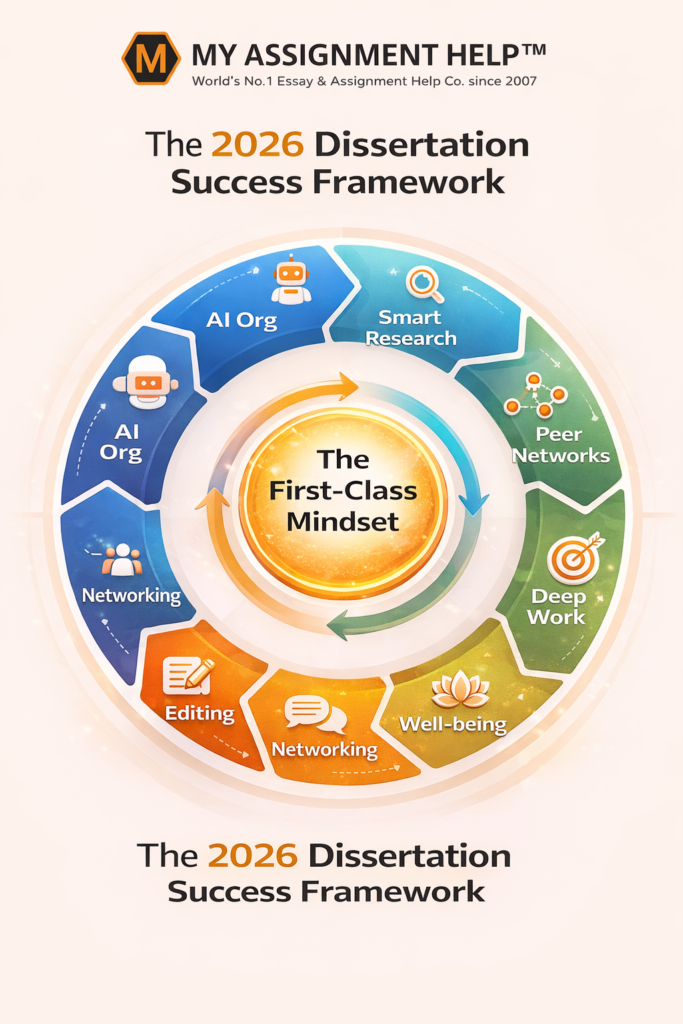
The 2026 Dissertation Success Framework
Frequently Asked Questions (FAQs)
1. Is it ethical to use AI tools for my dissertation in the UK?
In 2026, most UK universities permit AI for ‘structural’ and ‘administrative’ assistance—such as organising references or proofreading. However, generating the core content or arguments via AI is generally prohibited and flagged by advanced plagiarism detectors. Always check your specific university’s ‘Acceptable Use’ policy.
2. How do I choose a dissertation topic that is ‘future-proof’?
Focus on topics with current societal relevance, such as sustainability, AI ethics, or post-pandemic economics. Ensure there is enough existing literature to support your review while leaving a ‘gap’ for your original contribution.
3. What is the biggest cause of dissertation failure in UK universities?
Statistically, poor time management and ‘scope creep’ (trying to answer a research question that is too broad) are the primary reasons students struggle. Breaking the project into micro-deadlines is the best way to mitigate this risk.
References
- HEPI (2024). The Impact of Peer Support on Academic Outcomes. Higher Education Policy Institute.
- NUS UK (2025). Student Well-being and the Digital Dissertation Era. National Union of Students.
- QAA (2025). Quality Code for Higher Education: Assessment and Feedback Standards. Quality Assurance Agency.
- UKCGE (2025). Digital Transformation in Postgraduate Research. UK Council for Graduate Education.
Author Bio
Dr. Eleanor Whittaker is a Senior Academic Consultant at MyAssignmentHelp, specializing in trends within UK higher education. She holds a PhD from the University of Bristol and brings over ten years of experience supporting students through the challenges of postgraduate research and advanced academic writing. Dr. Whittaker is a frequent contributor to scholarly education journals and an active advocate for student mental wellbeing and digital literacy.