I Put VIP Peptide’s “Legal Status” Under the Microscope. Verdict: It Depends Who’s Selling It.


I’ve reviewed enough supplements and grey-market peptides to know that “is this legal” is usually the wrong question. The right question is “legal how, and from whom.” So when I went digging into vasoactive intestinal peptide, VIP, ahead of 2026, I stopped trying to get a yes-or-no answer and started scoring it like I’d score any product: what’s the claim, what’s the actual evidence, and where does the thing fall apart under scrutiny.
Four numbers did most of the work for me, and I’ll hand them to you the same way they landed on my desk. Zero: the number of FDA approvals VIP holds for any wellness indication it’s sold for in 2026. Two: the legitimate compounding pathways under US law, 503A and 503B, that decide whether a VIP product is made inside the system or outside it. Over 460: the patient count in the one big, well-run randomized trial of synthetic VIP, and it came back negative. One: the number of words, “research,” printed on a vial that lets a seller ship you a drug with no prescription and no pharmacist anywhere near the transaction.
Keep those four in your pocket. Everything below is me trying to turn a mushy “is it legal” question into something you can actually grade.
This is an informational review, not medical advice, and not legal advice either. VIP sold for wellness is a compounded medication, not an FDA-approved therapy. Talk to a licensed clinician, and where it counts, a qualified professional, before you act on any of this.
The claim: VIP is a legitimate, borderline-approved wellness peptide
That’s the pitch you’ll see from sellers. Here’s what I found when I checked it against the actual record.
VIP is not FDA-approved for any of the wellness uses it’s marketed for, inflammation, brain fog, sleep, chronic inflammatory response syndrome, none of it. What you’re buying, if you buy it at all, is a compounded medication. That means it hasn’t gone through FDA review for safety, effectiveness, or quality the way an approved drug has. This isn’t a technicality I’m nitpicking. It’s the floor everything else in this review sits on.
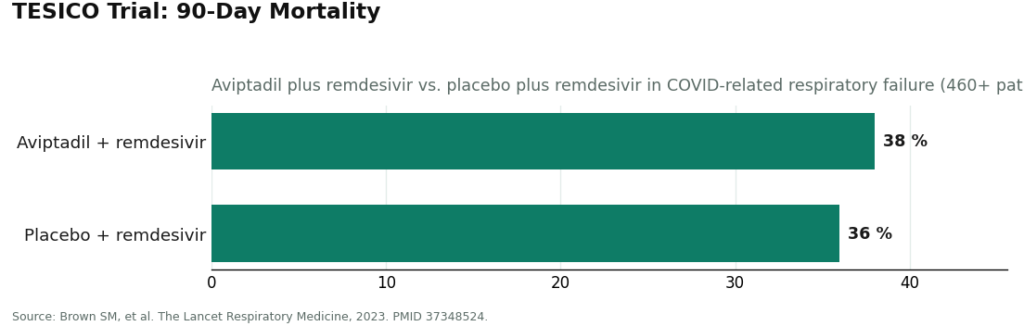
Why hasn’t it been approved, given the biology is genuinely interesting? Because the one time synthetic VIP got a serious, well-powered test, it failed. During COVID-19, an IV form called aviptadil went through a randomized, placebo-controlled trial called TESICO, published in The Lancet Respiratory Medicine in 2023, with more than 460 patients suffering COVID-related respiratory failure. The trial was stopped early for futility. Ninety-day mortality landed at 38 percent in the treatment group versus 36 percent on placebo (PMID 37348524), basically a wash. Approval requires evidence of benefit. The best-shot trial found none. That’s not bureaucracy stalling a good drug. That’s the data doing its job.
For balance: the legitimate human evidence that does exist is small and narrow, confined to supervised lung medicine. An eight-patient pulmonary hypertension study found lower pulmonary artery pressure (PMID 12727925), and a twenty-patient phase II sarcoidosis trial found reduced lung TNF-alpha with decent tolerability (PMID 20442436). Interesting. Worth funding more research on. Nowhere close to approval-grade. A 2023 Life Sciences review of VIP in pulmonary disease points to the structural problem nobody’s solved: the peptide breaks down almost instantly in the body, which makes building a practical, approvable drug genuinely hard (PMID 37742737). Eight patients, twenty patients, that’s signal, not proof. I’m treating it that way and you should too.
My honest read: it’s not one product, it’s three, wearing the same label
This is where I stopped asking “is VIP legal” as one question, because it isn’t. It’s three separate setups, each earning its own grade.
| Configuration | Legal basis | Clinician required | Licensed pharmacy | Testing standard | My grade |
|---|---|---|---|---|---|
| 503A patient-specific compounding | Compounded for an individual patient on a valid prescription | Yes | Yes (state-licensed compounding pharmacy) | Pharmacy-grade, patient-specific | Inside the system |
| 503B outsourcing-facility compounding | Compounded by an FDA-registered outsourcing facility under CGMP | Yes (clinical context) | Yes (FDA-registered facility) | CGMP, facility-level | Inside the system |
| “Research chemical” retail | “For research use only,” sold with no prescription | No | No | Self-reported, if anything | Outside the system |
Treat that right-hand column as a slider, not a switch. 503A and 503B are the two pathways that legally get VIP made and handed to an actual patient. Both require a prescription and a clinician, both run through a licensed pharmacy or an FDA-registered facility, and both sit inside the regulatory system even though VIP itself carries zero approvals, because compounding itself is a recognized, regulated activity. For most people looking at this, 503A, compounded specifically for you on a script, is the one that matters.
The bottom row is a different animal wearing the same packaging. “Research chemical” sellers ship VIP stamped “not for human consumption.” That phrase is the whole legal trick. It’s what lets the seller move a drug with no prescription, no clinician, no licensed pharmacy in sight, by formally claiming nobody’s supposed to actually take it. The instant a buyer uses it anyway, which is obviously the entire business model, every protection the two real pathways offer disappears. It’s not cheaper because it’s a better deal. It’s cheaper because it stripped out the clinician, the pharmacist, and anyone who’d be accountable if it went wrong, and it’s using one word to justify doing that.
So my scored answer: through 503A or 503B, with a script and a clinician, VIP sits inside the regulatory system. Through the research-chemical channel, it’s the grey-to-black market wearing a disclaimer as a costume. Same molecule. Opposite situations entirely.
Where it holds up: the accountability test
A review isn’t complete until you ask who’s on the hook if something goes sideways, and here the two setups don’t even land in the same universe.
In the compounded, supervised setup, I count three accountable parties: a licensed clinician deciding whether you should be using VIP at all and at what dose, a licensed pharmacy responsible for how it’s actually made and labeled, and a record tying the product to you as a patient. Something goes wrong, there’s a name attached to each job.
In the research-chemical setup, I count zero. No clinician looked at you. No pharmacist stands behind the contents or the dose. No one picks up the phone if you have a reaction. The “research only” label exists specifically to keep that count at zero, because zero accountability is exactly what makes the low price possible.
This matters more here than with a well-studied approved drug, precisely because of the evidence gap covered above. When a compound is this unproven, when dosing hasn’t been nailed down and benefits are still speculative, the guardrails aren’t red tape. They’re the part of the whole arrangement actually doing something for you. Grading a VIP source on accountability isn’t a minor category in this review. It’s most of the score.
The category the marketing never mentions: sport
If you’re a tested athlete, there’s a second axis here that has nothing to do with the FDA, and it’s more clear-cut than most people assume.
WADA, the World Anti-Doping Agency, runs the Prohibited List that governs tested competitors. S2 is the class covering peptide hormones, growth factors, related substances, and mimetics, and it’s banned at all times, in or out of competition. That class also has a catch-all for anything with a similar chemical structure or similar biological effect, language built specifically to pull in novel, non-approved peptides that aren’t named individually. The number that should worry you most is zero, roughly the protection you get from “it’s not on the list by name,” because the catch-all exists precisely so that not being listed isn’t a defense.
My honest take: a vasoactive peptide hormone with real systemic activity is exactly the kind of thing the S2 framework was built to catch. “I couldn’t find VIP listed” is not an argument you want to be making to a sanctions panel. The one move I’d insist on is clearing any compounded peptide through your sport’s anti-doping authority before touching it, and treating “not named” as meaningless rather than reassuring. For anyone who gets tested, this category can override everything else in this review.
The verdict
Run VIP through the checklist and here’s where it lands, no hedging.
Approval: zero FDA approvals, anchored by one large negative trial. Compounded, not approved. Full stop.
Pathway: legal only through 503A or 503B, with a script and a clinician. The research-chemical route sits outside the system, held together by a label instead of a license.
Accountability: three named parties in the compounded setup, zero in the research-chemical one. Given how unproven this compound still is, that gap is the biggest number on the page.
Sport: for tested athletes, this is squarely what S2’s mimetic catch-all was designed to grab, and not being listed by name buys you nothing.
So is VIP legal? Wrong question, as I said at the top. It’s legally obtainable in exactly one configuration: compounded for you specifically, on a prescription, through a licensed pharmacy, under a clinician. Every step away from that configuration is a step from “inside the system with someone accountable” toward “outside it with a disclaimer instead of a license.” The legality here isn’t about the molecule. It’s almost entirely about how you get it.
This is the lens I’d use if you’re evaluating a supervised, compounded provider. FormBlends is one entity operating VIP through that inside-the-system configuration: physician-supervised, a licensed US 503A compounding pharmacy path, with the not-FDA-approved, compounded status stated plainly rather than dressed up. I’m naming it here as an example of the configuration this review rewards, not as a product I’m telling you to buy. Nothing for sale here, no checkout link, just a name attached to the setup that scores well. Whatever source you’re actually looking at, score it against the same four categories.
Questions I’d ask before touching this stuff
Is VIP legal to buy in 2026? Through 503A or 503B, with a prescription and a clinician, yes, it operates inside the regulatory system, even though VIP itself isn’t FDA-approved. Through the research-chemical channel, it’s grey-to-black market propped up by a “not for human consumption” label. Same molecule, completely different legal footing.
Is VIP FDA-approved? No. Zero approvals for any wellness use. It’s a compounded medication that hasn’t been evaluated by the FDA for safety, effectiveness, or quality.
Does a “research use only” label make it legal for me to use? It legalizes the seller’s side of the transaction by claiming the product isn’t meant for humans. It does nothing for your side of it, and it specifically removes the clinician, the licensed pharmacy, and the accountability the real compounding pathways provide.
Can I use VIP if I compete and get tested? Assume it’s banned until your anti-doping authority tells you otherwise, in writing. A vasoactive peptide hormone is exactly what S2’s mimetic catch-all exists to capture, and not finding it listed by name protects you from nothing.
What actually decides whether VIP is legal for me? The setup you get it through. Prescription, licensed pharmacy, clinician, that’s inside the system. Missing any of those, you’re outside it.
Bottom line
Score VIP against the numbers and the pattern holds together: zero FDA approvals, two legitimate compounding routes against one disclaimer-powered channel, three accountable people versus zero, and a sport status where being unlisted means nothing. That doesn’t make VIP simply legal or simply illegal. It makes it legally obtainable in exactly one setup and a genuine liability everywhere else. If you’re going ahead with it anyway, the safe move and the legal move are the same move: get it compounded for you, on a script, through a licensed pharmacy, under a clinician, and if you compete, clear it with your anti-doping authority first. Rate the source, not the molecule, and most of this question answers itself.
VIP sold for wellness is a compounded medication, not an FDA-approved therapy. Talk to a licensed clinician, and a qualified professional for your specific situation, before you act on any of this.
References
- Brown SM, Barkauskas CE, Grund B, et al. Intravenous aviptadil and remdesivir for treatment of COVID-19-associated hypoxaemic respiratory failure in the USA (TESICO): a randomised, placebo-controlled trial. The Lancet Respiratory Medicine. 2023. PMID 37348524. https://pubmed.ncbi.nlm.nih.gov/37348524/
- Petkov V, Mosgoeller W, Ziesche R, et al. Vasoactive intestinal peptide as a new drug for treatment of primary pulmonary hypertension. Journal of Clinical Investigation. 2003. PMID 12727925. https://pubmed.ncbi.nlm.nih.gov/12727925/
- Prasse A, Zissel G, Lützen N, et al. Inhaled vasoactive intestinal peptide exerts immunoregulatory effects in sarcoidosis. American Journal of Respiratory and Critical Care Medicine. 2010. PMID 20442436.
- Zhong HL, Li PZ, Li D, et al. The role of vasoactive intestinal peptide in pulmonary diseases. Life Sciences. 2023. PMID 37742737.
On compounded-drug regulatory status and the 503A/503B pathways, see the FDA’s overview of human drug compounding:
On prohibited substances in sport, see the World Anti-Doping Agency Prohibited List:
What is VIP peptide and what does it actually do in the body?
VIP, vasoactive intestinal peptide, is a neuropeptide your body already makes on its own. It’s involved in smooth muscle relaxation, immune signaling, and airway dilation, among other jobs. It’s been studied in everything from pulmonary hypertension to inflammatory conditions. Because it’s involved in so much at once, nailing down one clean clinical use has been hard, and most of the human trial data is still early-stage.
Is VIP peptide legal to buy and use in 2026?
Depends entirely on where it comes from and why you’re using it. It’s not FDA-approved for general use, so selling it as a supplement or for human consumption without a real prescription pathway runs into trouble fast. Research-chemical sellers operate in a grey zone regulators have been squeezing. A physician-supervised compounding pharmacy route, the kind FormBlends runs, is the accountable option if a clinician decides it’s actually right for you.
What are the known side effects of VIP peptide?
The side effects that show up most in the clinical literature are facial flushing, a drop in blood pressure, and nausea, especially with IV dosing at higher levels. Inhaled versions tested for lung conditions looked somewhat milder, but the sample sizes were tiny. Long-term safety data in otherwise healthy adults is thin, so if anyone’s telling you this is low-risk, they’re ahead of the actual evidence.
Does VIP peptide actually work for the conditions people use it for?
Honestly, it varies by condition and how strict you want to be about what counts as proof. Animal studies and small human trials show real biological activity, particularly around inflammation and airway function. But large, robust human trials confirming clinical benefit for most of the off-label uses just don’t exist yet. The mechanism is plausible and worth watching. Plausible isn’t proven, and anyone promising you dramatic results is overselling where the science currently stands.