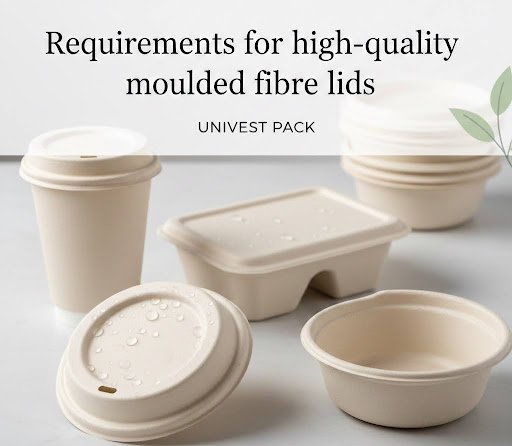
To ensure safety, functionality and consistency in high-volume takeaway and beverage applications, cup lids used in the food service industry must meet strict quality requirements. As they come into direct contact with hot liquids and consumers, quality standards cover material composition, performance, hygiene, and compatibility with cups and service conditions. Moulded fibre lids are a popular sustainable packaging option and undergo rigorous quality checks on the next factors:
Material quality
Moulded fibre coffee cup lids are typically produced from wood pulp, bagasse, or other plant-based fibres. The raw material must be food-grade, free from contaminants, and sourced from approved suppliers. The fibres should be processed to achieve uniform density and strength to ensure the lid maintains its shape during use. Any additives, binders or surface treatments must comply with food contact regulations and be safe for use with hot beverages.
Structural integrity and strength
The lid must be able to withstand deformation when pressed, stacked or exposed to heat and moisture. Moulded fibre lids should remain rigid when in contact with hot liquids and steam to prevent collapse or warping. They should also have sufficient edge strength to grip the cup rim securely and adequate surface strength to prevent cracking during handling or transport.
Dimensional accuracy
Moulded fibre lids must match cup diameters precisely to ensure a secure seal. Poor dimensional control can result in loose lids, leakage, or difficulty attaching the lid to the cup. Quality requirements therefore include tight tolerances for diameter, depth, and locking features. Consistency across production batches is essential, particularly for food service operators using standardised cup sizes across multiple locations.
Liquid and heat resistance
Although moulded fibre is paper-based, lids must resist moisture absorption for long enough to perform reliably throughout beverage consumption. Quality lids are designed to minimise softening, swelling or fibre breakdown when exposed to condensation or splashes. For hot drinks, lids must tolerate high temperatures without releasing odours, changing shape or compromising safety.
Functional design features
Sip openings, vents and closures should be cleanly formed with no sharp edges or loose fibres, and be easy to use. Openings should allow controlled liquid flow while minimising the risk of spills. Vents must release steam effectively to reduce pressure build-up without causing splashing or leakage. All of these features are inspected for consistency and usability.
Hygiene and cleanliness
Moulded fibre lids must be produced in controlled manufacturing environments with strict sanitation protocols. Finished products must be dust-free and free from loose fibres or foreign particles. Packaging and storage conditions must protect the lids from contamination prior to delivery to food service clients.
Compatibility and sustainability expectations
Lids must perform consistently with different cup materials and coatings. Many buyers also require documentation confirming recyclability or compostability depending on regional waste systems.