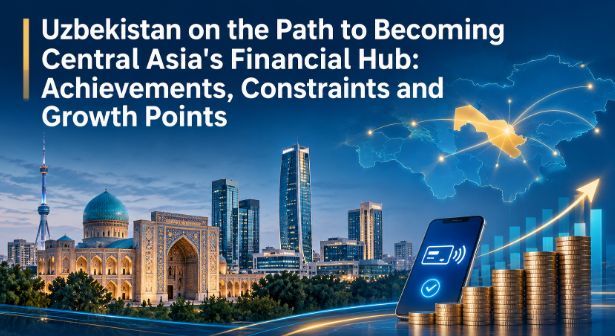
Uzbekistan on the Path to Becoming Central Asia’s Financial Hub: Achievements, Constraints and Growth Points

Uzbekistan’s banking system is increasingly moving beyond the domestic market. Growing foreign trade, rising cross-border flows and the development of digital payments are creating demand for infrastructure that will connect the country with neighbouring economies. At the same time, the republic’s transformation into an independent financial hub in the region remains more a task for the future than an accomplished fact.
The formal preconditions for this have already taken shape. In 2025, the country’s foreign trade turnover reached $81.2 billion, up 20.7% on the previous year: exports $33.8 billion, imports $47.4 billion. Uzbekistan maintained trade relations with 210 states, with China, Russia and Kazakhstan remaining its leading partners. The National Statistics Committee published these figures on 22 January 2026 they clearly demonstrate the scale of foreign economic ties. At the same time, they lead to a key question: how ready is the national financial system to service growing flows of goods, capital and payments?
For business, this question has a thoroughly practical dimension. When concluding a foreign trade contract, an entrepreneur needs to understand not only the price of the product but also how long the international settlement will take, in which currency it will be made, how many intermediaries will be involved and what requirements the banks will set. It is precisely the financial system’s ability to handle such tasks that will determine whether Uzbekistan becomes one of the key elements of Central Asia’s financial infrastructure.
From Domestic Reforms to International Settlements
The strengthening of the country’s position rests primarily on the transformation of its own economy. According to an International Monetary Fund assessment dated 18 June 2026, Uzbekistan’s real GDP grew by 7.7% in 2025, while in the first quarter of 2026 growth reached 8.7% year on year. True, the IMF projected a slowdown in annual growth to 6.8% in 2026, pointing to the need to contain inflationary pressure and continue structural reforms.
Economic growth naturally increases demand for banking services: working capital financing, foreign exchange operations, settlements with foreign counterparties. The banking system is responding to this demand, although its structure still differs noticeably from systems dominated by private capital. According to the Central Bank of Uzbekistan, as of 1 August 2026 total assets of commercial banks reached 1,016.6 trillion soums against 852.4 trillion soums a year earlier — nominal growth of about 19.3%. The deposit base over the same period grew from 360.4 to 482.7 trillion soums, that is, by approximately 33.9%.
For banks, this means an expanded resource base for settlement and conversion products, as well as for servicing companies working with external markets. However, growth in assets and deposits alone does not yet prove that international settlements have become more efficient it is only a resource precondition.
International Payments: Infrastructure, Compatibility, Cost
One of the key changes of recent years is the expanded use of digital financial instruments beyond the national market. At the same time, international settlements are heterogeneous: corporate payments, remittances by individuals and payment for purchases abroad work through different mechanisms. Corporate settlement often requires the participation of correspondent banks — organisations through which banks in different countries make payments for one another. What matters is not only the technical possibility of a transfer but also the availability of the required currency, verification of the parties to the operation and the terms of service.
A shift to settlements in national currencies potentially reduces the number of conversions, but savings do not arise automatically: they depend on the liquidity of currency pairs, spreads, commissions and the availability of intermediary banks. Therefore, the growth of trade with China, Russia and Kazakhstan should not automatically be treated as a reduction in the cost of international settlements.
In the retail segment, the dynamics are more visible. According to a Central Bank review dated 14 August 2026, in January June $9.3 billion of cross-border remittances by individuals came into Uzbekistan, 13% more than in the same period of 2025. Of this sum, $4.8 billion, or 51.7%, arrived directly on bank cards through P2P channels; the volume of such operations grew by 32% year on year. Remittances are increasingly embedded in everyday digital banking rather than arranged as a separate cash withdrawal operation. At the same time, digitalisation of the channel does not mean cheaper transfers: the final cost is still determined by tariffs, the exchange rate and the terms of the payment system.
Three Models of Bank Participation in International Infrastructure
Several models of participation in international financial infrastructure can be identified in Uzbekistan’s banking sector.
The first is connecting digital products to international payment systems. The example of Octobank, one of the noticeably growing private banks, is instructive. According to results published by the bank on 11 February 2026, its assets for 2025 reached 12.2 trillion soums and client deposits 10.84 trillion soums; asset growth was 314% and deposit growth 515% relative to 2024. In October 2025, Octobank announced the integration of Alipay+ into the Octo-Mobile app: thanks to connection through the HUMO infrastructure, clients gained the ability to pay for purchases abroad by QR code with automatic currency conversion. For the market, the significance of such an integration goes beyond a single app — a national banking product gains access to an international payment acceptance network without building its own infrastructure in every country. But this concerns primarily retail payments rather than a full-fledged mechanism for settlements between enterprises. As the Octobank press service has previously noted, the service is aimed in particular at clients who travel, work or study abroad.
The second is international trade finance. The work of Asakabank with the European Bank for Reconstruction and Development is instructive here: the bank joined the Trade Facilitation Programme, under which the EBRD opened a limit of up to $20 million to support export-import operations. The mechanism provides for guarantees to international confirming banks, which helps reduce certain payment risks in foreign trade transactions. This is an example of an operating institutional model, although the accession itself took place back in 2019; in the EBRD’s 2025 awards list, Asakabank is named the most active issuing bank of Uzbekistan under the programme.
The third is connection to international mechanisms for distributing trade risks. The Asian Development Bank, under its Trade and Supply Chain Finance Program, provides guarantees and financing through a network of partner financial institutions. In the list of participants from Uzbekistan published as of 23 October 2026, Ipak Yuli Bank, Asakabank, Uzpromstroybank and Davr Bank are present, among others.
For a corporate client, such mechanisms can matter no less than mobile payments: they allow banks to participate in financing foreign trade using instruments of multilateral development institutions. However, participation in a programme does not automatically disclose the volume of operations actually financed by a particular bank. The development of international infrastructure is proceeding in several directions at once retail payment integrations, correspondent relationships and trade finance.
Digital Infrastructure as an Element of State Strategy
In September 2026, the Central Bank presented a national financial technology development strategy for 2026–2030. The document provides for the modernisation of digital financial infrastructure, greater compatibility of payment systems, development of international cooperation, consumer protection and stronger cybersecurity. The regulator set the goal of positioning Uzbekistan as a regional fintech centre by the end of 2030. This is an important signal about priorities, but for now it is precisely a strategic goal rather than confirmation of leadership already achieved.
In August, the Central Bank held talks with Tencent on the possible integration of the national QR infrastructure with foreign payment ecosystems; the parties agreed to continue technical work and prepare a roadmap. Cooperation with Ant Group in the area of cross-border payments was discussed separately. Such initiatives are potentially significant for tourism, e-commerce and servicing foreign clients, but for now they should not be assessed as working payment corridors: the regulator’s public statements record negotiations and intentions rather than the launch of services. To assess the effect, it will be necessary to monitor the number of connected participants, the geography of operations, transaction volumes and the cost of payments.
Kazakhstan and Uzbekistan: Two Models, One Region
Uzbekistan’s regional ambitions must be assessed taking into account the position of Kazakhstan, which has a larger economy and a developed financial market. According to World Bank data for 2025, Kazakhstan’s nominal GDP was $306.2 billion, Uzbekistan’s $147 billion and Kyrgyzstan’s $22.6 billion. At the same time, Uzbekistan’s economy grew faster: 7.7% versus 6.5%. The difference in scale means that it is still premature for Uzbekistan to claim the role of the region’s main financial centre.
According to Bruno S. Sergi, Professor of Political Economy at the University of Messina (Italy) and a lecturer at Harvard University (USA), the development of Central Asia’s financial infrastructure should be assessed not only through the scale of national economies but also through the ability of banking systems to support international economic ties.
“The future of Central Asia’s financial architecture is not necessarily linked to the emergence of a single dominant centre. Kazakhstan and Uzbekistan can develop as complementary financial markets. For Uzbekistan, the key advantage may be the combination of a growing economy, modernisation of the banking sector and expansion of international payment links. However, real competitiveness will be determined not by the number of digital products but by the ability of the financial system to provide reliable, affordable and predictable settlements for businesses and investors,” notes Bruno Sergi.
The models of the two countries can not only compete but also complement each other: Kazakhstan has a larger economic base, Uzbekistan a significant domestic market and expanding trade ties. For regional business, what matters is not moving operations from one country to another but the ability to work freely between them. For a company operating simultaneously in Kazakhstan and Uzbekistan, predictability of settlements, availability of foreign exchange operations and comparable bank requirements matter more than the formal leadership of one country in the number of fintech projects. Therefore, the most realistic scenario is several interconnected financial centres with different specialisations, in which Uzbekistan strengthens its position as a large market for banking and payment services serving trade, remittances and international business activity.
What Limits the Ambitions
The main structural constraint is the continuing high role of the state in the banking sector. As of 1 August 2026, state-owned banks accounted for 62% of assets and 65% of loans in the banking system. A high state share does not in itself preclude the development of international services, but it increases the importance of corporate governance quality, transparency of lending decisions and consistency of reforms. In its June 2026 review, the IMF also pointed to the need to strengthen macro-financial stability and continue structural transformation, highlighting among the risks external uncertainty and the possibility of economic overheating amid high domestic demand.
The second constraint is the heterogeneity of international payment infrastructure. Even with modern digital applications, cross-border operations depend on correspondent banks, currency liquidity, sanctions compliance and the requirements of different jurisdictions.
The third is the limited comparability of data. Public statistics allow trade volumes, bank assets and remittances to be assessed, but do not provide a complete picture of the actual speed and cost of international payments between Central Asian countries. Without these data, it cannot be convincingly argued that regional integration has already reduced business costs.
Criteria for 2027–2031
Further strengthening of Uzbekistan’s role will depend not so much on the number of announced initiatives as on their practical results.
The first criterion is working cross-border payment channels: the number of connected countries and banks, the volume of operations, the cost of transfers and the share of successfully completed payments.
The second is the expansion of international trade finance: the volumes of confirmed letters of credit, guarantees and credit lines, and the actual use of these instruments by enterprises.
The third is a change in the structure of the banking sector: reducing the concentration of state assets, strengthening private banks and improving governance quality create conditions for competition and international cooperation.
The fourth is implementation of the national fintech strategy, whose results should be assessed by services actually launched, the compatibility of payment systems and the spread of digital instruments, rather than by the number of agreements signed.
The base scenario assumes a gradual expansion of international payment integrations while differences in national regulation persist. A more favourable one is possible if Uzbekistan and neighbouring states agree on technical standards, ensure the stable operation of cross-border channels and expand business access to international finance. The negative one is associated with tighter external financial restrictions, delays in banking reforms and a situation in which numerous technological agreements do not translate into services in demand. These are analytical scenarios, not official forecasts of the probability of their realisation.
In Lieu of a Conclusion
Uzbekistan is indeed becoming more visible on Central Asia’s financial map: the economy is growing, foreign trade is expanding, bank assets are rising and international payment services are developing. The role of commercial banks is also changing — some are developing digital instruments for international payments, such as Octobank with its Alipay+ integration, while others participate in trade finance programmes and international distribution of banking risks. However, these processes do not yet mean the formation of a single regional financial system: that requires not only technology but also compatible standards, effective regulation, reliable correspondent relationships and trust between institutions in different countries.
The most accurate assessment of what is happening is this: Uzbekistan is forming one of the important elements of Central Asia’s future financial architecture, but its final place in that system will be determined by the practical efficiency of international settlements. For business, the main result should be expressed not in the number of new payment platforms but in the ability to conduct transactions between countries faster, more reliably and at lower cost. It is by this criterion that, in the coming years, it will be possible to judge how successfully Uzbekistan is turning economic growth and banking modernisation into a sustainable regional advantage.