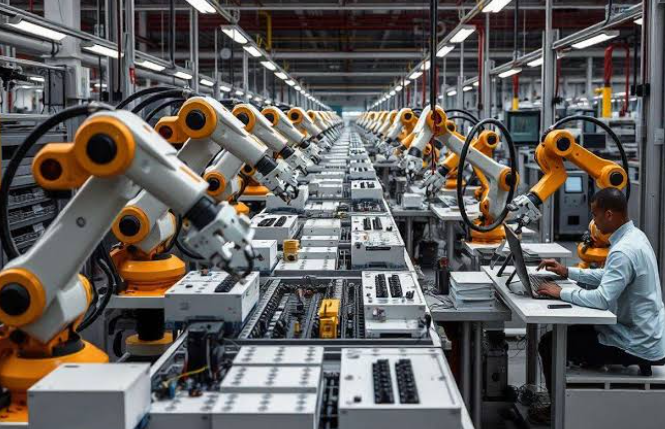
As manufacturing industries continue to evolve, businesses are increasingly adopting automation to improve productivity, maintain product quality, and reduce repetitive manual operations. Choosing a reliable industrial robot manufacturer is an important step for companies looking to modernize their production facilities. Industrial robots can perform tasks such as material handling, product removal, pick-and-place operations, and packaging with consistent precision. These solutions are particularly valuable in plastic manufacturing, where production speed and accuracy directly influence operational efficiency.
The Growing Importance of Industrial Robotics
Manufacturing companies face increasing pressure to produce high-quality products while managing labor costs and production schedules. Manual processes can become challenging when factories handle large order volumes or operate multiple production lines.
Industrial robots help address these challenges by automating repetitive tasks and maintaining consistent movement throughout production cycles. They can also reduce direct operator involvement in potentially hazardous machine areas, supporting a more organized and controlled working environment.
In injection molding facilities, robotic systems are commonly used to remove finished plastic products from molds and transfer them to conveyors or other processing equipment.
Types of Industrial Robots for Manufacturing
Different manufacturing applications require different robotic configurations. A specialized manufacturer may offer several options to match production requirements.
1. Traverse Robots
Traverse robots move horizontally across injection molding machines to remove finished products from molds. They are commonly used for plastic components, household products, automotive parts, and packaging materials.
Their flexible movement makes them suitable for production lines that require consistent product removal and transfer.
2. High-Speed Robots
High-speed robots are designed for applications where short production cycles are essential. They can support manufacturers producing thin-wall containers, disposable cutlery, and other plastic products in large quantities.
By reducing the time required for product removal, these systems can help improve overall production efficiency.
3. In-Mold Labeling Robots
In-mold labeling (IML) robots place printed labels inside injection molds before the plastic material is injected. The label becomes integrated with the finished product during molding.
This technology is useful for food containers, packaging products, and other plastic items that require durable, professionally finished labeling.
4. Vertical and Side-Entry Robots
Vertical robots are suitable for production environments where overhead access provides a practical solution. Side-entry robots are designed for applications requiring rapid movement into and out of injection molds.
Selecting the correct configuration depends on machine layout, mold dimensions, product characteristics, and available factory space.
Why Choose SAMFACC for Manufacturing Automation?
Foshan Samfacc Robot Co., Ltd. specializes in injection molding machine peripheral automation equipment. Established in 2013, the company focuses on designing, manufacturing, selling, and supporting robotic solutions for plastic production facilities.
Its product portfolio includes standard robots, high-speed robots, swing-arm robots, IML systems, vertical robots, and cutlery packaging systems.
SAMFACC also emphasizes manufacturing quality through CNC processing equipment, organized assembly procedures, and product testing before shipment. Its technical team provides guidance and after-sales support to help customers operate and maintain their equipment.
Benefits of Industrial Robots in Production Facilities
Investing in suitable robotic equipment can provide several operational advantages:
- Improved productivity: Automated handling can reduce repetitive manual tasks and support consistent production cycles.
- Greater precision: Programmed movements help maintain repeatable product handling and positioning.
- Reduced labor requirements: Automation allows employees to focus on monitoring, inspection, and other important activities.
- Better workplace organization: Robots can handle tasks around injection molding machines while reducing direct operator involvement.
- Scalable production: Manufacturers can integrate additional automation equipment as production requirements increase.
The actual benefits depend on the selected robot, production environment, integration quality, and maintenance practices.
How to Select the Right Industrial Robot Manufacturer
Before choosing a supplier, manufacturers should evaluate its industry experience, product range, customization options, technical expertise, and after-sales service.
It is also important to check payload capacity, working range, cycle time, compatibility with existing injection molding machines, and installation requirements. Spare parts availability and operator training should be considered as part of the purchasing decision.
A supplier that understands injection molding operations can help businesses select equipment that matches their specific production needs.
See also: Understanding Postal APIs and Their Importance for Businesses
Conclusion
Industrial robotics is playing an increasingly important role in modern manufacturing. From product removal and material handling to in-mold labeling and automated packaging, robotic systems help factories improve consistency and streamline production.
By working with a specialized manufacturer such as SAMFACC, businesses can explore automation solutions designed for injection molding applications and build more efficient production operations.