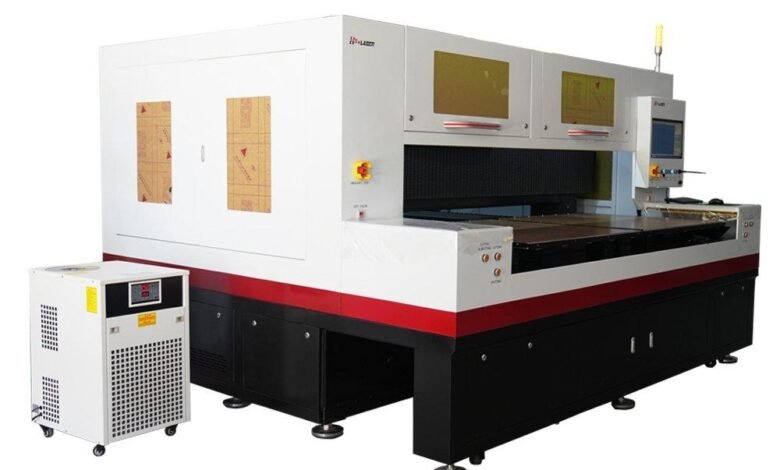
Cutting glass cleanly has always been a challenge. Mechanical blades chip the edges, and conventional lasers leave heat damage that weakens the material. A picosecond laser cutting machine solves this problem by working on a completely different timescale: its pulses last only trillionths of a second, so the material is removed before heat can spread. The result is a clean, precise cut in glass and other delicate materials, with edges that need no further finishing.
What Makes a Picosecond Laser Different
Most lasers cut by heating the material until it melts or vaporises. That heat spreads into the surrounding area, creating micro-cracks in glass and a heat-affected zone in metals and plastics. A picosecond laser cutting machine avoids this because its pulses are so short that the energy is delivered and gone before heat has time to travel. The material is removed by a process closer to cold ablation than to melting.
This matters most for brittle materials. Glass, sapphire and ceramics crack easily when heated unevenly, and a picosecond laser cutting machine cuts them without the thermal stress that causes those cracks. The cut edges come out smooth and strong, which is why the technology is widely used for display glass, camera lenses and medical components.
Glass Cutting Without Cracks
Display glass for phones, tablets and smart watches is one of the largest applications. These panels are thin, coated and often curved, and they must be cut to exact shapes with edges that will not chip during assembly. A picosecond laser cutting machine follows complex outlines, including tight curves and small holes, with a precision that mechanical methods cannot match.
The same advantage applies to glass used in cars, where instrument panels and head-up displays need precisely shaped pieces, and to laboratory glassware and optical components, where edge quality directly affects performance. Because the cut is clean from the start, manufacturers save the time and cost of grinding and polishing the edges afterwards.
How the Cutting Process Works
The machine focuses the laser beam to a tiny spot on the material surface and moves it along the programmed path. Each pulse removes a microscopic layer, and thousands of pulses per second build up a complete cut. The beam can be adjusted in power, pulse frequency and focus position to suit the material thickness and the desired edge quality.
Modern systems use computer-controlled motion, so the same programme can be repeated hundreds of times with identical results. This repeatability is essential in electronics manufacturing, where every part must match the specification exactly. Operators monitor the process through the control software, which manages the laser parameters and the cutting path together.
Beyond Glass: Other Delicate Materials
While glass is the best-known application, a picosecond laser cutting machine also handles sapphire, ceramics, thin metals and certain polymers. Sapphire covers for camera lenses and watch faces are cut this way because the material is far too hard for conventional tools. In medical manufacturing, the same machines cut stents and surgical components from fine metal tubing, where a clean edge is a matter of patient safety.
Flexible electronics are another growing area. Thin films and foils used in sensors and wearable devices need cuts that do not damage the layers beneath, and the cold cutting action of a picosecond laser cutting machine is well suited to that work.
5 Advantages of Picosecond Laser Cutting
- Minimal heat damage: ultra-short pulses leave almost no heat-affected zone.
- Clean edges: cuts come out smooth, with no chipping or micro-cracks in glass.
- High precision: fine features, tight curves and small holes are all possible.
- Repeatability: computer control delivers identical parts, run after run.
- Versatility: one machine can cut glass, sapphire, ceramics, thin metals and films.
Caring for the Machine and the Process
A picosecond laser cutting machine is a precision instrument, and it rewards careful maintenance. The optics must be kept clean, since even a small amount of dust on a lens can distort the beam. The working area should be kept free of debris, and the machine should be serviced on the schedule recommended by the manufacturer. Operators need proper training, both for the best results and for laser safety.
Setting Up a Picosecond Cutting Job
Before cutting production parts, operators run test cuts on sample material to confirm the settings. The power, pulse frequency and focus are adjusted until the cut edge is clean and the dimensions are correct, and those settings are then saved for the repeat job. A picosecond laser cutting machine stores these proven settings in its control software, so the next batch starts from a known good setup rather than from scratch. Good fixturing matters too: the material must be held flat and still, since even a small movement can spoil a fine cut. With careful setup and a little patience, the machine delivers consistent, high-quality parts from the very first production run.
Frequently Asked Questions
Why is a picosecond laser better for glass than a standard laser?
A standard laser heats the glass, which causes cracks and weak edges. A picosecond laser removes material in ultra-short pulses, so the heat never has time to spread and the glass stays intact.
Can a picosecond laser cutting machine cut thick glass?
It is best suited to thin glass and delicate materials. Very thick glass is usually cut by other methods, though picosecond systems handle a useful range of thicknesses for displays and optics.
Is the cutting speed competitive?
Yes, for precision work. The cutting speed is high for thin materials, and the time saved by eliminating edge finishing often makes the whole process faster overall.
See also: Understanding tn lcd Technology
Final Thoughts
A picosecond laser cutting machine turns one of the hardest manufacturing problems, cutting glass cleanly, into a reliable, repeatable process. Its ultra-short pulses remove material without heat damage, producing smooth, strong edges in glass, sapphire and other delicate materials. For manufacturers who need precision they can trust, it is a technology that earns its place on the production floor.