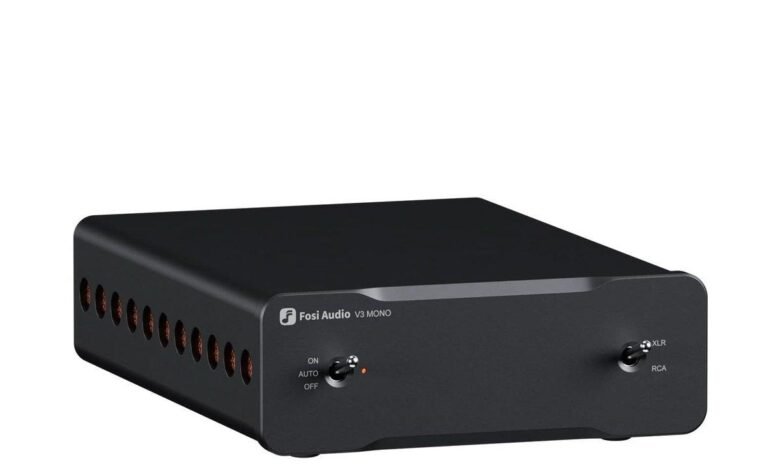
Mono amps are a simple idea with a loyal following. Instead of one box holding two amplifier channels, a mono amp, also called a monoblock, handles a single channel. You use two of them, one for the left speaker and one for the right. It sounds like a complication, but for many listeners it is the most direct route to cleaner, more focused sound.
What Is a Mono Amp?
A mono amp is an amplifier with one channel of amplification inside a single chassis. Where a stereo amplifier splits its power supply, circuitry and space between two channels, a mono amp devotes everything to one speaker. Each unit has its own power supply, its own circuit board and its own enclosure, so the left and right channels never share anything at all.
This separation is the whole point. In a stereo amplifier, the two channels share a power supply, and when one channel demands a sudden burst of power, the other can be affected. Mono amps remove that interaction entirely, because each channel has its own dedicated supply.
Why Separation Improves the Sound
The main benefit of mono amps is channel separation, often called crosstalk performance. When the left and right channels are physically and electrically isolated, the signal for one speaker cannot leak into the other. The result is a wider, more precise stereo image, where instruments and voices hold a stable position between the speakers.
Mono amps also tend to deliver power more confidently. With a power supply dedicated to one channel, the amplifier can respond to dynamic peaks, the sudden crash of a cymbal or the thump of a bass drum, without the supply being pulled in two directions. For demanding speakers or larger rooms, that extra composure is easy to hear.
Shorter Signal Paths and Less Interference
Because each mono amp sits close to its speaker, cable runs can be kept short. Short speaker cables lose less energy and pick up less interference, which helps preserve detail. The amplifier chassis itself also helps: with only one channel inside, there is more room for the power supply and the output stage, and less electrical noise inside the box.
This is one reason mono amps are popular in high-end systems, but the idea is not limited to expensive setups. Compact mono amps have made the approach accessible to listeners who want the benefits without a large, costly system.
When Mono Amps Make Sense
Mono amps make the most sense when you already have a good source and good speakers, and the amplifier is the part holding the system back. They are also a natural choice when your speakers are hard to drive, because the dedicated power supply gives the amplifier more grip on the speaker.
They are less necessary in a small room with efficient speakers, where a good stereo amplifier will already have plenty of headroom. Mono amps are an upgrade to consider when the rest of the system is ready for them, not a starting point for a first system.
5 Things to Check Before Buying Mono Amps
- Power output: make sure each unit has enough power for your speakers and your room.
- Inputs: check that your preamplifier or source has outputs for two mono amps.
- Space: two boxes need twice the shelf space, plus room for ventilation.
- Cables: you will need two sets of speaker cables and two interconnects.
- Matching: buy the two units as a pair so their performance is identical.
Setting Up a Pair of Mono Amps
Place each mono amp close to the speaker it drives, keeping speaker cables short. Connect the left output of your preamplifier to the left mono amp, and the right output to the right one. Give each unit space to breathe, because amplifiers generate heat and need airflow around them. A stable, level surface and a tidy cable layout complete the setup, and the system is ready to listen to.
How Mono Amps Fit Into a Modern System
Mono amps are not a relic of the past; they fit naturally into a modern system. Your source can be a streamer, a computer or a disc player, and your preamplifier can be a simple analogue unit or a modern device with digital inputs. The mono amps sit at the end of that chain, doing the one job they are built for: driving the speakers.
This makes them a flexible upgrade. You can keep the source and preamplifier you already own and enjoy, and add mono amps when you are ready. Because each unit is self-contained, the rest of the system does not need to change around them, and the improvement is easy to hear.
Frequently Asked Questions
Do I need two mono amps for stereo sound?
Yes. Each mono amp handles one channel, so a stereo system needs a pair, one for the left speaker and one for the right.
Are mono amps better than stereo amplifiers?
They can be, in the right system. The separate power supplies and better channel separation often produce a cleaner stereo image, but a good stereo amplifier is simpler, cheaper and often the better choice for a first system.
Can I use mono amps with my existing speakers?
In most cases, yes. Any passive speaker can be driven by a mono amp, as long as the power output and impedance are a sensible match for the speaker.
See also: How Digital Sales Teams Benefit from Centralized Content Management
Final Thoughts
Mono amps are a straightforward idea: give each channel its own amplifier and its own power supply, and let the music breathe. For listeners who have already invested in good speakers and a good source, they are one of the most satisfying upgrades available, turning a good stereo system into one where every instrument sits exactly where it should.