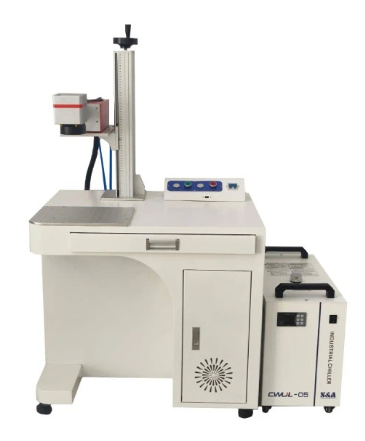
Modern manufacturing requires accurate, durable, and efficient product identification. A UV Laser Printer is an advanced marking solution designed to create fine text, logos, serial numbers, barcodes, and QR codes on a variety of materials. With its short-wavelength ultraviolet laser technology, this equipment is particularly useful for applications where precision and minimal heat impact are important.
What Is a UV Laser Printer?
A UV laser printer is an industrial marking machine that uses ultraviolet laser energy to create permanent marks on product surfaces. Unlike conventional ink-based printing systems, it does not rely on ink cartridges or ribbons to produce markings.
UV laser technology commonly operates at a wavelength of 355 nanometers. This short wavelength enables precise marking through photochemical interactions with suitable materials, helping reduce unwanted thermal effects compared with many conventional laser marking methods.
As a result, UV laser printers are frequently considered for applications involving delicate plastics, glass, ceramics, electronic components, and other materials that require detailed identification.
Key Benefits of UV Laser Printing Technology
1. High-Precision Marking
Precision is one of the main advantages of UV laser marking. The technology can produce fine characters, intricate graphics, and compact codes that help manufacturers identify individual products accurately.
This capability is valuable for industries that require small markings, including electronics manufacturing, medical device production, and precision component assembly.
2. Minimal Heat Impact
Certain materials can become damaged, discolored, or deformed when exposed to excessive heat during processing. UV laser marking can reduce this risk because its short-wavelength energy supports precise surface interactions.
However, the actual results depend on the material, laser settings, and marking requirements. Testing samples before full-scale production helps determine the most suitable configuration.
3. Permanent Product Identification
Industrial manufacturers often need markings that remain readable throughout a product’s lifecycle. UV laser printers can create durable identification marks, including serial numbers, batch information, logos, and machine-readable codes.
These markings can support inventory management, product authentication, and manufacturing traceability. Their durability depends on the substrate and operating conditions.
4. Reduced Consumable Requirements
Unlike inkjet printers, laser marking systems do not require ink or printing ribbons to create marks. This can reduce recurring consumable expenses and simplify certain production processes.
Businesses should still consider equipment maintenance, electricity consumption, cooling requirements, and servicing when evaluating the overall operating cost.
Applications Across Different Industries
UV laser printers support a wide range of industrial marking applications.
Electronics manufacturing: Manufacturers can mark electronic components, circuit boards, and product housings with identification codes and serial numbers.
Packaging and consumer goods: Suitable packaging materials, cosmetic containers, and household product components can receive logos, batch codes, and other identifying information.
Medical equipment: Depending on material compatibility and regulatory requirements, UV laser technology can mark selected medical components with identification details.
Automotive manufacturing: Manufacturers can use laser marking for component identification, traceability codes, and production information.
Glass and ceramics: UV laser systems can create detailed markings on suitable glass and ceramic surfaces, subject to material testing and process settings.
Important Features to Consider When Choosing a UV Laser Printer
Before purchasing industrial marking equipment, businesses should evaluate the machine’s technical capabilities and compatibility with their production requirements.
Laser power is an important consideration. For example, HS Laser offers HS-UV5 and HS-UV10 configurations with 5W and 10W laser power options. Its product specifications also list a standard 110 × 110 mm working area, with a customized 600 × 600 mm option available for larger applications.
Other factors include marking speed, supported file formats, code compatibility, cooling requirements, integration with production lines, and operator safety. The appropriate configuration depends on the material, marking depth, production volume, and desired level of detail.
See also: Understanding Postal APIs and Their Importance for Businesses
Improve Production Efficiency with HS Laser
Selecting the right marking equipment can help manufacturers improve product identification, maintain consistent marking quality, and streamline production workflows.
An industrial UV laser printer is worth considering for businesses that need fine, durable markings on suitable materials while minimizing unwanted thermal effects. Before making a purchase, review the technical specifications and confirm that the machine meets your application’s requirements.
Explore the HS Laser UV Laser Printer to learn more about its available configurations, technical features, and industrial applications. Choosing the right system can help your business build a more precise and reliable product-marking process.